PublishedStandalone Article
The Miracle That Became Ordinary
On how we learned to name things, follow the right procedure, and stopped looking at the world long enough
Original language: CZ/Available in: EN / CZ/15 min read
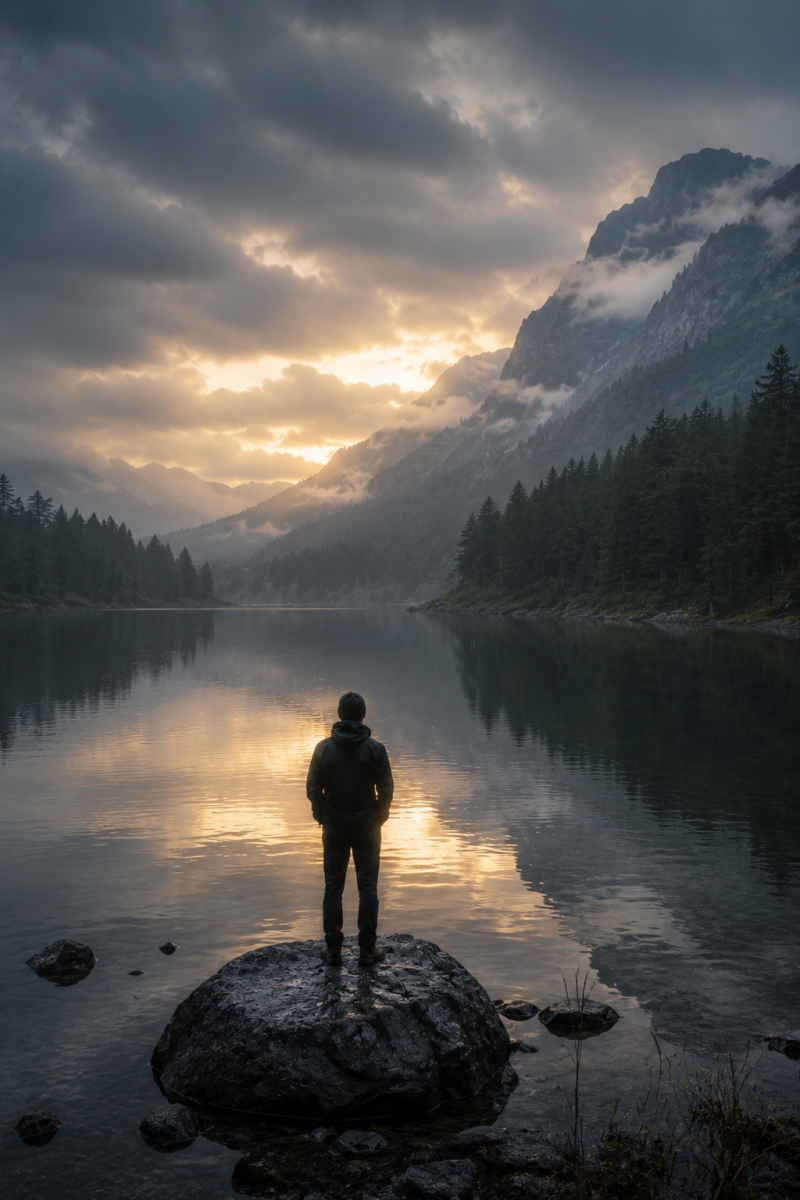
On how we learned to name things, follow the right procedure, and stopped looking at the world long enough
As children, we could stop at things that often pass unnoticed before an adult eye. An airplane in the sky was not a transport connection, a noise above the city, or a reminder of a delayed flight. It was an event. A metal machine high above our heads, somehow staying in the air despite its weight, carrying people, fuel, calculations, materials, lift, navigation, and a piece of human courage. A child watches it until it disappears. An adult often looks up only if it interrupts a sentence.
It is not that adults understand the world less. Often they understand it far more. They know what an airplane is, what a train is, a bridge, a camera, a river, a cloud. They can classify these things, use them, appreciate them, repair them, plan around them, avoid them, or criticize them. But this is where a quiet paradox appears. A person can know more and still see less. We can name something correctly and, in doing so, gain the feeling that we already truly know it.
Adulthood often teaches us to use the world before we have time to admire it. A train becomes a connection that is five minutes late. A bridge becomes a piece of infrastructure we need in order to get to the other side. An animal becomes a species, an attraction, a photograph, or a short video. A camera becomes a device that “takes pictures,” although it is still a strange instrument capable of holding light, memory, and a moment still. A bridge is not only concrete and steel. It is physics, material, trust, and human labor stretched across empty space. Every car that crosses it silently confirms that its structure holds.
As a child, I was especially fascinated by space shuttles, airplanes, and cars. From nature, the sea and sharks stayed with me most strongly — things that seem obvious in an encyclopedia, and yet almost improbable when one truly imagines them. An enormous mass of water, and beneath it a living world older than our cities, our roads, and our worries. Today, of course, I know more. I know more names, more contexts, more technical details. But sometimes I wonder whether, precisely because of that, we need to return consciously, from time to time, to the simple act of looking.
Wonder has not disappeared. It only has a harder time breaking through the layer of obviousness. Sometimes it arrives when I look at the sharpness of a photograph taken through a good lens, and suddenly see a detail I would have missed with the naked eye. Sometimes it comes while listening to an old first-press CD on a hi-fi system, when music stops feeling like background and becomes a space. Sometimes it happens during a night walk, when a hedgehog appears in the grass and briefly reminds me that alongside our practical world, another world is still running — smaller, quieter, and largely indifferent to us.
And sometimes it is only a tennis stroke. Not a winner, not a decisive point, not a moment that would make it into a highlight reel. Just a stroke in the middle of a rally that lands exactly right. The ball flies cleanly, the body makes the correct movement, the sound of the racket briefly falls into place. We often watch the result: who won the point, who made the mistake, who won the match. But how much beauty is lost simply because the score does not count it?
Things have not lost their miraculous quality. We simply give them less time. A person walks the same path after two weeks, and the landscape is different: another color in the trees, another light, another air, another angle of the day. A place they thought they knew has quietly changed. Perhaps we have not lost a world full of wonders. We have only learned to walk past them too quickly.
School gives us language for the world. It teaches us that a tree has a species, a leaf has a shape, flight has physical laws, history has periods, and cities have dates, names, styles, and contexts. All of this is valuable. Without names, the world would be blurred, difficult to share, and much harder to grasp. Naming is one of the first ways in which a person begins to build landmarks in the landscape of reality.
But this is also where something can quietly go wrong. A name should be the beginning of a relationship with the world, not its end. A definition can open a door, but it should not immediately close it again. When knowledge is reduced to a chapter, a concept, a note in an exercise book, and the correct answer on a test, a person can easily gain the impression that they have understood something, even though in reality they have only classified it.
A curriculum is a map. But a map is not the landscape.
At school, I often had the feeling that we were mainly learning how to answer. Less often did we learn how to stay with things long enough for them to become questions inside us. I missed ordinary observation without immediate purpose, without testing, without grading, without the need to prove at once that I had noticed the right thing. School often tells us what something is called. Less often does it let us stand beside it in silence for a while.
Biology can teach the names of trees, the structure of a leaf, and Latin terminology. But it does not always teach a person to stand under a tree and look at the structure of its branches, the bark, the light, the asymmetry, the small life around the trunk, and the change of season. The word “tree” is correct. But by itself, it is not enough.
Physics can explain flight. And it should. Knowing about lift does not have to destroy wonder; on the contrary, it can deepen it. The problem begins only when flight becomes merely a formula for a test, and the airplane merely an example in a textbook. History can provide dates and concepts, but the past sometimes truly opens only when a person stands in an old town, at a railway station, in a museum, or beside a stone wall, and suddenly feels that history was not a chapter, but a real world.
The strongest teachers, for me, were those who could use the curriculum as a springboard, not as a fence. At secondary school, I had a civics teacher who gave us more than he had to. Not because he ignored the subject, but because he knew how to create a space in which a person could think, ask questions, connect things, and briefly step outside the machinery of school. Lessons like that stay with a person longer than many precisely memorized definitions.
Something similar is beautifully captured in the Czech film The Elementary School (Obecná škola) and in the character of Mr. Hnízdo, the teacher. When he notices the boys’ curiosity, he begins to speak about what genuinely interests them. Not because the curriculum is useless, but because he recognizes a living moment. He sees that interest has just appeared, and lets it burn for a while. To me, that is one of the greatest gifts of a good teacher: not letting a question die simply because it is not currently on the schedule.
By contrast, learning dozens of names, periods, and historical figures without any interest in who those people were, what they created, why they created it, and what kind of world they came from often made me feel more tired than enlightened. Not because names are unimportant. But a name without a story is only a label. And a label by itself rarely awakens a relationship.
I felt this strongly with languages. The biggest shift in my English did not come when I learned another hundred words. It came when I stopped being so afraid of making mistakes and started treating the language as something alive. Trying sentences, speaking imperfectly, looking for rhythm, using language as a space rather than a test. Suddenly it was not only about correctness. It was about relationship.
In a similar way, I knew Greece from school. History, islands, cities, concepts, myths, antiquity. But a real relationship with it began only when I was there. When a name became a place, a map became a landscape, and a school chapter became air, stone, sea, light, and my own journey.
Knowledge is not the problem. Knowledge without attention is. Sometimes we learn the correct answer before we have asked our own question. And perhaps that is where the quiet loss of wonder begins: not when we understand the world, but when we believe too early that there is nothing more to see.
There are areas where following the correct procedure is an act of humility. A pilot in the cockpit, facing a crisis, is not there to prove their originality. They need to go through the checklist, verify the data, follow the procedure, and do exactly what protects the lives of the people behind them. In the same way, a surgeon, dispatcher, technician, or anyone working in a critical operation cannot rely only on intuition and a good feeling. In such places, discipline is not a limitation on creativity. It is a way of holding the world together.
It is good that we learn some things through repetition, control, and precision. Without that, medicine, transport, technology, and much of science would fall apart. Not every improvisation is courage. Sometimes it is only irresponsibility. Procedure matters where it protects life, safety, and quality.
The problem begins when this mode of thinking expands to the whole of life. Not every value is created by flawlessly repeating a procedure. There are professions where a mistake can kill. And there are areas where fear of mistakes kills discovery.
A person who writes, photographs, travels, invents a game, builds their own website, searches for a style, or learns to look more carefully cannot function only by checklist. Method, regularity, and craft can help. But real movement often begins at the moment when a person allows themselves to turn aside. To try something they cannot yet do. To look somewhere else. To make a mistake that is not a failure, but information.
At university, where I studied in a mathematically oriented field, I gained many things for which I am grateful: precision, discipline, technical competence, the ability to stay with a difficult problem. These are not small values. At the same time, after a while I felt that some subjects were beginning to resemble one another. Another introduction to another area, another set of definitions, another method, another exam. As if the material changed, but the basic movement remained the same.
For me, real discovery often began only when I figuratively climbed over the fence of the curriculum. Not in order to reject school, but to reach questions that did not fit inside it. Experimenting, having space to make mistakes and learn from them, entrepreneurship, personal judgment, the ability to try things on one’s own — all of these are difficult to teach in the format of lesson, assignment, submission, evaluation.
A large part of one’s own judgment is not formed by receiving the correct solution. It is formed in conversations, disputes, attempts, errors, deeper discussions with friends, where opinions are not handed in like a test, but tuned. There, a person inspires others and is also corrected, moved, unsettled. It is not always comfortable. But it is alive.
Schools and large organizations often teach well what can be checked: procedure, output, deadline, standard, correct answer. They teach less well what needs silence, time, and personal direction: taste, character, attention, working with uncertainty, a sense of proportion, the ability to stay with a question even when it does not immediately produce a measurable result.
The right procedure is sometimes the beginning. At other times, it is a cage. Alongside schools, corporate processes, and proven methods, we also need our own small laboratories. Places where we are allowed to try something without immediate evaluation. Photography, writing, travel, a website, a game, a conversation, a personal project, a detour that does not look useful at first. That is where a person learns things that cannot be easily measured, but without which the world would remain only a set of tasks, procedures, and correctly submitted outputs.
To name something is not the same as seeing it. It is a simple sentence, but the longer one stays with it, the less obvious it becomes.
A name helps us. It gives the world shape, order, and communicability. When we say tree, train, bridge, camera, Athens, or Paris, we know roughly what we are talking about. When we know a procedure, we know how to handle something, repeat it, repair it, use it, pass it on. A name and a procedure are tools of orientation. Without them, we would get lost in the abundance of the world.
But every tool has its temptation. When we name something, we gain a certain control over it. When we know the procedure, we gain the feeling that we have mastered it. And that is where a subtle loss of attention can begin.
A person says “tree” and walks on. But a tree is not merely an entry in a dictionary. If one stops beside it, one sees the shape of the branches, the age of the trunk, the light in the leaves, traces of weather, asymmetry, small insects, the season, and time stored inside it for far longer than we spend passing by. The word was correct. It simply was not the whole thing.
In the same way, a person says “train” and means a connection, a line number, a delay, a platform, or a journey home. But when one truly looks, one sees construction, the rhythm of wheels, rails stretched through the landscape, the sound of metal, the history of transport, and the old human desire to overcome distance. Suddenly it is not just a means. It is a piece of civilization in motion.
Travel can reveal this difference with great precision. A person can know Athens or Paris from geography, history, photographs, and films. They can know the monuments, district names, dates, and basic stories. But a relationship begins only when they move there at their own pace.
When they get lost, stop, and look at stone, light, water, a façade, an ordinary street, and people who are not there for their discovery, but because they live there.
Photography perhaps helps me with this most of all. It forces me to look longer than would be practical. Suddenly a person does not see only a street, but layers of light, proportions, a reflection in glass, the direction of a gaze, empty space in the composition, a small detail that would otherwise disappear. A good camera is not only a technical instrument. It is a device for slowing attention. It makes a person step back, wait, recompose, and look again.
Large buildings, bridges, skyscrapers, mountains, lakes, airplanes, and trains can astonish me precisely when I stop treating them as obvious scenery. And the same is true of small things. A hedgehog on a night walk is not grand in the usual sense. It is not monumental. But when a person stops beside it, suddenly there is a piece of the world that lives next to us, without our control, without our plans, and without our evaluation.
What matters is that true seeing does not mean throwing knowledge away. It does not mean pretending not to know. It means not allowing a name or procedure to stand between us and the world like opaque glass. Knowledge can deepen wonder. But only if it remains open.
A real relationship with something begins where correct procedure is no longer enough. And true seeing begins where we dare, for a moment, not to know everything immediately. To let a tree be a tree before it becomes a concept. To let a city be a place before it becomes an item on a map. To let a tool be a possibility before it becomes a function.
Sometimes very little is enough: to slow down, look a second time, and admit that even something we know by name may be something we have never truly seen.
Wonder needs stopping. Consumption needs continuation.
Perhaps this is one of the quietest contradictions of the modern world. We have access to more things, places, images, tools, and information than ever before, but their very availability often teaches us to remain one step ahead. Look, use, photograph, order, share, tick off, continue.
Consumption itself is not bad. A person needs to use things, travel, shop, work with technology, search for information, and sometimes simply enjoy something quickly. The problem begins when this mode becomes the only way of relating to the world. When nature, a city, a building, an animal, culture, or knowledge also turns into an item. Something that should be quickly available, quickly understood, and quickly replaced by the next item.
A tourist arrives at a famous place, takes a photograph, and leaves after a few minutes. Formally, they were there. They have proof that they visited the place. But perhaps they did not have time to look at the light, the material, the sound of the space, the people around them, the details in the wall, their own feeling, or the strange tension between what they knew about the place in advance and what actually appeared before them. An experience is not the same as an item on a list.
It is similar with technology. A new phone, camera, computer, or car can be technically incredible. The result of the work of thousands of people, decades of development, materials, calculations, mistakes, corrections, and small improvements. But very quickly it becomes a version, a specification, a price, a review, a tool. We use it, but rarely stop at the sheer improbability that such a thing exists at all.
Photography is ambiguous in this sense. It can be a way of quickly possessing an image: I was there, I have a photo, done. But it can also be the exact opposite. A way of looking more slowly. When a person arrives at a place before sunset, sets up a tripod, and waits, they cannot simply consume the world. They have to stay. Over several dozen minutes, the light, colors, air, shadows, and even one’s own mood change. A place that might have seemed ordinary during a quick walk-through begins to have a story.
Some places stayed with me precisely because I stopped there. Mount Athos, the monastic peninsula in Greece where ordinary tourism does not easily reach, stayed with me as a space where time moves differently. Not as an attraction, but as a particular kind of presence. The American West, in turn, showed me that powerful places are not always the most famous ones. Rocks, canyons, views, forgotten roads, places without a big sign and without a clear Instagram point. A person stops there and suddenly discovers that this was where something truly left an imprint.
And then there are places a person passes too quickly. For me, one such place is Seligman in the American West. We drove through it quickly. Only later did I realize that it was not just a point on the route, but a town with a history of American motoring, travel, and old Route 66. A place that deserved at least a moment. To get out, walk around, look at the details, let the atmosphere work on me. Sometimes a person does not regret that they failed to see something. They regret that they saw it too quickly.
The modern world constantly tempts us in this direction. The internet gives answers within seconds. That is miraculous. But sometimes it kills the question before it has ripened. Animals become content, buildings become attractions, places become lists, things become reviews, and knowledge becomes quick information. The world has not emptied out. We have only learned to move through it quickly.
And perhaps that is why it is worth slowing down from time to time — not out of moral duty, but for ourselves. Some things are interesting not because they are new. They are interesting because we finally gave them time.
Wonder does not have to be lost forever. But we usually do not return to it by the same road on which we knew it in childhood. A child’s wonder often comes from a first encounter, from not knowing, from the fact that the world does not yet have fixed outlines. Adult wonder is different. It is not a lack of knowledge. It is a decision not to let knowledge close everything.
A person does not have to forget names, procedures, experience, or discipline. They do not have to pretend they do not know what a tree, bridge, train, camera, or airplane is. On the contrary. The more one knows, the deeper one’s wonder can become, if one keeps the ability to truly look. Adult wonder is the ability to know and still be astonished.
To see the structure of a bridge and still not lose the feeling of its quiet courage. To understand a camera and still feel the strangeness of the fact that it can capture light, time, and the mood of a single moment. To know the name of a tree and still stop to notice how its branches have changed after two weeks of different weather.
Sometimes it is enough to stay a little longer. A photographer sees an ordinary street differently from an ordinary passerby. Not because the street is more exceptional, but because the photographer gives it more time. Suddenly they see light on glass, a reflection in a shop window,
the rhythm of windows, the silhouette of a person, the color of evening, a small movement in the scene that they would not have noticed while simply passing through. The street has not changed. The attention has.
I think we also learn this kind of attention from other people. My girlfriend often stops at small things I might otherwise miss. A small detail in nature, a flower, an animal, a light, something inconspicuous along the way. Not showily, not as a program, but naturally. As if some things simply should not be skipped. And for that, she deserves a great thank-you.
For me, there is an important reminder in this: sometimes we see little not because we lack eyes, but because we have grown used to aiming too quickly at what comes next.
Adult wonder is not a return to naivety. It is a discipline of attention. A conscious decision to keep, alongside work, procedures, results, plans, and screens, some space for a gaze that does not immediately have to deliver anything. For a question that does not instantly have to turn into an answer. For a place that does not have to be ticked off. For a thing that does not have to be used at once.
Photography, travel, writing, and personal projects help me with this precisely because they create small laboratories of attention. When photographing, one learns to wait. When traveling, one learns to step off familiar routes. When writing, one returns to things that would otherwise remain only vague impressions. In a personal project, one learns to build a world in one’s own way, not merely fill in a prepared form.
My own website is one of these laboratories for me. A place where there does not have to be only a quick post, an immediate reaction, and another item in the feed. There can be a photograph, an article, a journey, a board game, a mechanism, an idea, an attempt, a note, a small world gradually taking shape. Not because it should change the internet. But because some things are worth attention and need a space where they do not disappear after a few seconds.
Perhaps we do not need to enchant the world again. Perhaps it is enough to stop treating it as if it were already exhausted. To let a name be a beginning, not a full stop. To let a procedure be a tool, not a cage. To let a photograph be a way of seeing, not merely proof of presence.
And then, sometimes, something ordinary happens. An airplane crosses the sky. A tree changes after two weeks. A hedgehog moves in the grass. A ball flies cleanly across a tennis court after a perfect stroke. A street briefly receives the right light. And a person realizes that the miracle may never have disappeared.
It was only waiting for us to look at it again.