PublishedStandalone Article
Why Have Your Own Website
On personal websites, borrowed platforms, and the quiet value of having a space that does not disappear into the feed.
Original language: CZ/Available in: EN / CZ/10 min read
On personal websites, borrowed platforms, and the quiet value of having a space that does not disappear into the feed.
Sometimes you open a social network with the simplest intention. You want to look at someone’s work, find a little inspiration, answer a message, compliment a photograph, or read a short note. You arrive for one thing. And within moments, you are somewhere else.
Between the posts, an advertisement appears. Then a recommendation. Someone else’s argument. A short video. Another impulse, another detour. None of this is necessarily bad. Social networks can be useful. They connect people, remind us of events, show work, and open doors to things we might never have found otherwise. The problem is not their existence, but the fact that their rhythm is rarely set by the person moving through them.
You can keep publishing there. A photograph, a short reflection, a work update, a memory from a journey, a thought that suddenly feels important. For a while, it appears. Someone sees it, someone does not. A few reactions arrive. And then it slowly sinks lower, covered by the next layer of traffic. It does not disappear completely, but it loses the place where it could naturally continue to live.
The feed can make a moment visible. It is less able to preserve a world.
Perhaps this is where the need for a personal website begins. Not as an escape from the internet, but as an attempt to have one’s own room within it. A place where things are not arranged only by freshness, performance, or the probability of a reaction. Where a photograph does not have to be just another item in the stream, but can belong to a gallery. Where a text does not have to fight for attention between an advertisement and a stranger’s comment, but can remain part of a broader theme. Where a project does not have to be reduced to a brief update, but can become a trace of a certain way of thinking.
A social network is a public square. It can be lively, useful, sometimes inspiring. You can meet people there, overhear a conversation, show something to passers-by. But a square is not a home. People do not usually build their library, gallery, or study there. They bring something into a space that has its own rules, its own noise, and its own interests.
A personal website follows a different logic. It is not a stream that opens and immediately starts disappearing. It is more like an address. You can place something there, plant it, connect it, and let it remain. Not so that it is hidden, but so that it has somewhere to belong.
You do not have to reject platforms to feel the need for a space of your own. It is enough to notice that being visible somewhere is not always enough. Sometimes it matters more to have somewhere to return.
A personal website can begin in a very practical way. As a portfolio. A professional profile. A place where you can send a link. You want to show what you do, what you have worked on, what you understand, and how you can be contacted. That is the first layer: the façade, the main entrance, quick orientation for someone who has only stopped by for a moment.
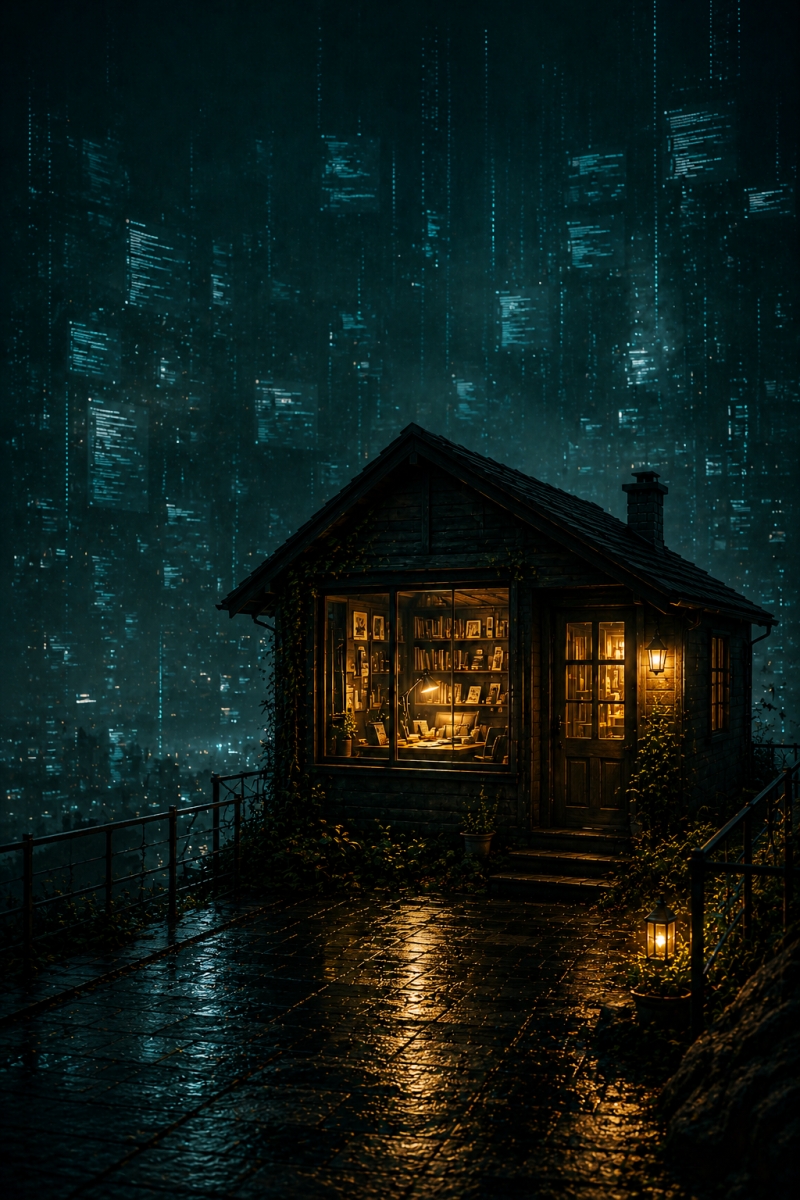
But once other rooms begin to appear behind the homepage, something changes. The website stops resembling a shop window and begins to resemble a house.
The homepage is the entrance hall. Projects and work are the study: software, data, applications, tools, concrete results. Photography and travel are both gallery and journey. Articles and documents feel like a library. Board games and worldbuilding become a workshop or a playroom, where not everything has to be finished yet — and precisely because of that, the process can still be felt. Downloads may be a little like a cellar or an attic: a place for materials, notes, and things one can take away. Contact is the door leading out.
A house is not just a façade. It has rooms, corridors, quiet corners, and things hidden in cupboards. In a similar way, a personal website does not have to be only a list of sections. It can become a way of arranging different parts of one’s world so that relationships begin to form between them.
That is the difference from platforms. LinkedIn shows professional experience. Instagram shows photographs. GitHub shows code. Each of these places has its purpose and, in many ways, makes sense. At the same time, they often separate one part of a person from another. A personal website can place them side by side. Not forcibly, not as a mixture of everything, but as a house in which different things have different rooms.
A software project does not have to stand far away from an article about music or film. A travel gallery does not have to be only a row of images without a wider atmosphere. The concept for a board game does not have to wait until it can fit into a short post. All these things can exist in one place, because in some quiet sense they belong together.
Work, photography, journeys, texts, games, and ideas are not separate lives. They are different ways in which a person thinks, creates, observes, and assembles the world around them.
A good personal website, then, is not just a billboard. It is a map. At first glance, it may show what a person does. At second glance, it may begin to suggest the world they are gradually building around it.
Not everything important has to be on the homepage. Some things have value precisely because they have to be reached. Not because they are deliberately hidden or made to seem rare. Rather because they need a little quiet, a second look, and a visitor who has not come only to pass through quickly.
In ordinary digital space, detours are often treated as inefficient. A person is supposed to arrive, find information, click, react, and leave. But a personal website can work differently. It does not have to be only a direct path from headline to button. It can have corners, like a city, a library, or an old house.
Someone arrives because of a possible professional collaboration. They look at projects, experience, technologies, and ways of working. And then perhaps they stay a little longer. They open a travel gallery. They pause at a photograph from the mountains, at a quiet city, at water, at a road that is not rushing anywhere. They do not have to know what happened before or after the shutter was pressed. Still, they may feel that the photograph is not just an item in a gallery. It carries light, weather, a journey, tiredness, the joy of a place, a brief moment of stillness. Something that can only partly fit into a caption.
Another visitor may wander into an article. Perhaps a text about music, film, or the things that stay with us. Maybe they do not read the whole thing. Maybe just one paragraph. But sometimes even a paragraph is enough to recognize that you are on a similar wavelength with the author. Or that you disagree, but in an interesting way. That has value too. The text is then not just content that passed in front of someone’s eyes. It becomes the beginning of a possible conversation.
It is these corners that give a personal website its human dimension. Projects show what a person can do. Photographs show what they notice. Travel builds a map of memories. Articles form an archive of thought. Games and worlds remind us that creativity does not always have to fit into a professional category. And unfinished ideas can sometimes speak almost as strongly as finished outputs, because they show direction, interest, and a way of searching.
I like things with a longer dramaturgy, a more complex structure, and their own inner world. Songs that arrive somewhere. Films that close. Games that have rules, a map, and a story. Texts one can return to. In the fast online space, such things are often difficult to show. They are too long for a post, too slow for a feed, too personal for a purely professional profile.
On a personal website, they can simply exist.
They do not have to shout that they matter. It is enough that they have their place. And those who look more carefully can find them.
Some places do not come into being quickly. They have to be inhabited. It is not enough to build them once, fill them with a few links, and declare them finished. A person returns to them, adds something, moves something, lets something mature. A personal website can begin as a practical presentation, but over time it can become a long-term space. Not a finished picture, but a house in which more rooms gradually begin to light up.
In an age of fast digital content, such a place has value precisely because it does not have to be fast. It does not have to prove every day that it is new. It does not have to keep asking for attention. It can grow more slowly than the feed, but more deeply. One day a gallery is added, another day an article, later a project, a note, a game, a document, or a small idea that does not yet belong anywhere else.
After a while, it is no longer only about individual files. The trace of the person who placed them there begins to appear.
For me, a personal website is exactly this kind of long-term project. A place where I can add ideas, photographs, texts, creations, and professional experience in my own style and voice. The portfolio is the first layer. It matters, because someone may only want to take a quick look, understand what I do, and move on. That is perfectly fine. But beneath that layer there can be a personal archive: quieter, wider, and less immediate.
I like the thought that several years from now I may return to an older photo gallery, article, project, or note and see not only the result. I will see a way of thinking from a certain time. What interested me, where I was looking, what questions I was asking, what images, films, songs, journeys, or games stayed with me. Perhaps something will feel imperfect. Perhaps today I would write or build certain things differently. But that belongs to an archive. It does not preserve only finished forms. It also preserves the path.
I also like the idea of a visitor who, after some time, discovers something older. Not the newest post. Not the item currently highlighted. But a text, a photograph, or a game that has been quietly lying in its place for a while. Perhaps they read an old article and realize that it still speaks to them. Perhaps they open a travel gallery and pause at a photograph that is no longer new, but still carries the mood of a place. Perhaps they find an unfinished world or an idea that was never just a short update.
That is the difference between content that expires and a place that remains.
A personal website does not have to shout. It is enough if it holds together the things that would easily fall apart elsewhere into separate fragments: work, photographs, journeys, articles, games, notes, ideas, and the quiet connections between them.
Perhaps, precisely in the age of platforms, a personal website makes sense again. Not as a rejection of the internet, but as a slowing down of it. As a small address where one can stay for a while.
At first glance, a portfolio. At second glance, a place.